philosophy major
I majored in Philosophy at UC Berkeley. People sometimes ask about my philosophy training and say things like, “there should be more Philosophy majors in tech.” I’m never quite sure what they mean by that.
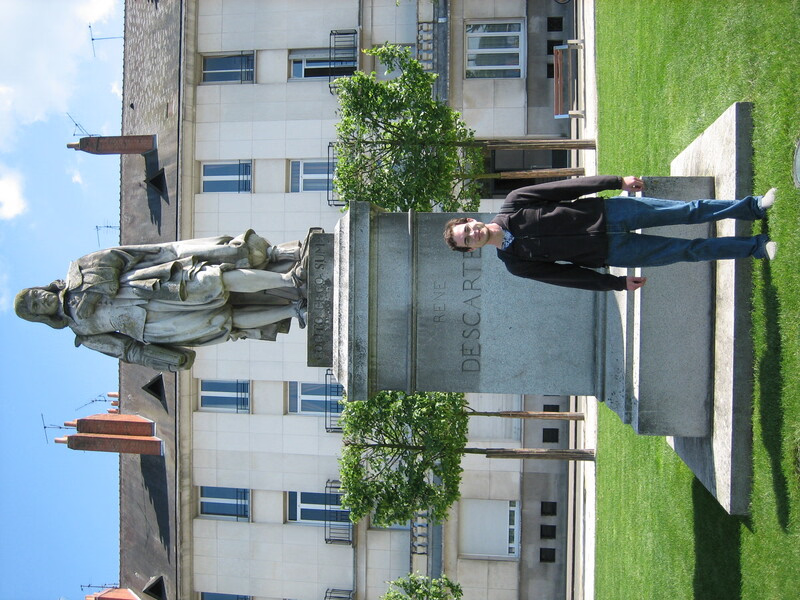
I do know that I loved studying Philosophy. Here’s a picture of me from 2007 in Tours, France, thrilled to have found a statue of Descartes (and also to have finished the end-of-year exams):
My wife likes to remind me how in college I would spend hours lying on a couch, deep in thought. When she’d ask me what I was doing, I’d just mutter, “working.” That was the semester I took upper-division Kant. She went with me to one of the lectures. Heavy stuff: the nature of reality, the limits of human knowledge. She thought it was funny how the professor pulled at his shirt buttons, while the grad students fidgeted in their seats and stroked their beards.
I studied some famous thought experiments: brains in vats, zombies, twin earth. Some of them aren’t so theoretical anymore. After all, what is a smartphone but a fancy version of Otto’s notebook? Squint at an LLM, and it looks an awful lot like the Chinese Room. I’ve heard that most people now say they’d choose a hedonistic experience machine over reality. Maybe with Roblox they can.
My junior year I moved to London to study at King’s College. There were lovely walks along the Thames, long hours reading in Senate House Library. I once borrowed a copy of Locke that was nearly a century old. Undergraduates had scribbled in the margins.
I had vague ambitions to start a software company from my dorm room and hacked together a Mac application to play jazz chords. I regretted giving up on a CS minor after failing discrete math the year before and didn’t know what I would do after graduation. The global economy was unraveling. It helped to read the Stoics.
One of the last courses I took was Metaphysics with Barry Stroud, then in his seventies. He never started a class, exactly, just stood silently at the front of the room, speaking only when everyone had given their attention. Then he would tell us about what he called “The Quest for Reality.” He had an elegant argument against the subjectivity of color, expressed in a few short sentences, that took me a week to understand. On the last day, someone asked him if he would have chosen to go to Philosophy graduate school again. He said no, that the competition had become too fierce, that you couldn’t fall into Philosophy as a career like he had in the sixties.
2009 was a terrible year to graduate, the lowest point of the Great Recession. The commencement speaker worked in finance and was still employed. He claimed studying Philosophy had prepared him to read the dense, technical language of bank regulations. This was directed mostly at the parents, I think. Don’t worry, your kids haven’t wasted your money on a Philosophy degree!
Yes, I learned skills that turned out to be useful in the software industry. Reasoning from first principles. Refuting arguments, anticipating objections. Asking good questions. A few times I’ve drawn truth tables. I don’t think Philosophy is the only way to learn these things, but that’s how it worked out for me.
Somewhere around year seven of my tech career, I found myself riding BART from Berkeley to San Francisco to work at a startup. There were a lot of conversations there about money. Stock valuations. COGS. The most expensive sushi. I heard a coworker, one year out of college, use the phrase “dynastic wealth.” From another, with more experience, “golden handcuffs.”
There was time to read, on the train. Barry Stroud had passed away that August. I bought a copy of his first book, the one about David Hume. It was comforting, remembering the arguments of that 18th century Scotsman. “Pain and pleasure, grief and joy, passions and sensations succeed each other, and never all exist at the same time. It cannot, therefore, be from any of these impressions, or from any other, that the idea of self is deriv’d; and consequently there is no such idea.” Downtown Berkeley, Ashby, Embarcadero, Powell. It was easy to think of the passing stations as a sequence of disconnected perceptions, arriving one after the other.